
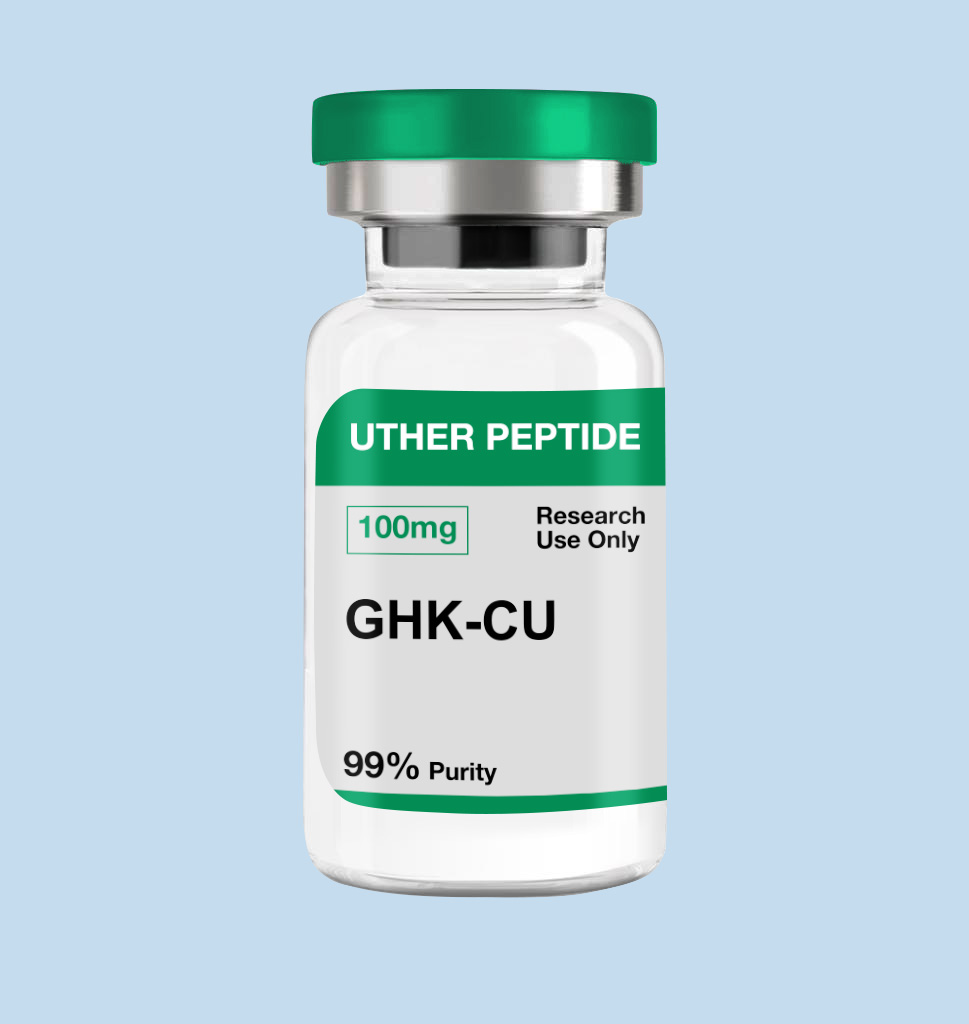
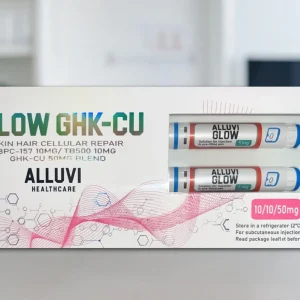
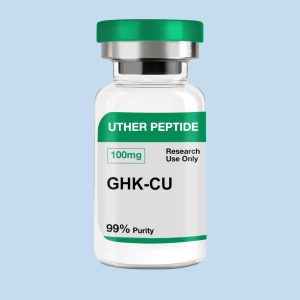
GHK CU Peptide 100mg (10 Vials / Kit)
 GHK-Cu is a naturally occurring small peptide in the human body that binds copper ions and facilitates their delivery to cells. Research indicates that it plays a significant role in tissue repair, collagen production, and skin regeneration. The peptide also supports proper enzyme function, reduces oxidative stress, and exerts anti-inflammatory effects that may help mitigate chronic inflammation and promote healing. GHK-Cu has been investigated in wound care, dermatology, and anti-aging applications, demonstrating improvements in skin elasticity, cellular repair, and overall cellular health.
Mechanisms of GHK-Cu
Copper is both essential and potentially hazardous: it is critical for enzymatic and redox activities, yet excess amounts can cause oxidative damage. The GHK sequence appears optimally designed to maintain this balance. It forms a stable yet flexible coordination with Cu(II) ions through the amino group of glycine, the imidazole nitrogen of histidine, and the ε-amino group of lysine — effectively keeping copper in a bioavailable yet regulated state.
The dynamic nature of this binding is notable. A competing ligand or shift in local redox conditions can prompt the peptide to release copper, allowing GHK-Cu to deliver it to enzymes and tissue sites involved in healing and oxidative regulation. Evidence suggests the peptide supports cellular homeostasis by transporting copper through reversible redox cycling and ligand exchange.
Preclinical Research Findings
In Vitro Studies: Protein Synthesis and Cellular Response
Laboratory studies demonstrate that GHK-Cu can stimulate cellular regeneration. When exposed to the peptide, fibroblasts and keratinocytes increase their production of collagen and elastin — key extracellular matrix proteins. This likely explains the enhanced adhesion, proliferation, and wound-healing responses observed in GHK-Cu-treated cultures. These effects have been linked to the activation of tissue repair genes, although whether they are driven by the copper component, the peptide itself, or their combined interaction remains unclear.
Antioxidant and Anti-Inflammatory Effects
GHK-Cu also neutralizes reactive oxygen species and supports the enzymatic functions of copper. This dual activity reduces both oxidative damage and chronic inflammation. In certain experiments, GHK-Cu lowered levels of inflammatory cytokines, suggesting potential benefit in conditions where inflammation and oxidative stress overlap — such as aging skin or metabolic stress. However, the majority of available data remains preclinical, and translating these findings into consistent clinical outcomes presents ongoing challenges.
DHK-Cu: Untapped Potential
DHK-Cu has received considerably less attention than its counterparts, yet it may exhibit distinct biological behavior. Unlike glycine or alanine found in other variants, DHK’s aspartic acid residue introduces a negatively charged side chain that could influence copper binding and interactions with cell membranes — potentially affecting the peptide’s tissue distribution and binding affinity. While much of this reasoning remains speculative, even minor sequence differences can have meaningful biological consequences. Without direct, head-to-head comparisons between GHK-Cu, AHK-Cu, and DHK-Cu, our understanding of structure–function relationships in this peptide family remains incomplete.
GHK-Cu vs. DHK-Cu vs. AHK-Cu
All three peptides share the histidyl-lysine motif as their copper-binding core, but their differing N-terminal residues — glycine, alanine, or aspartic acid — may modestly affect their stability and biological efficacy. GHK-Cu is well established as a promoter of tissue remodeling; AHK-Cu is associated with hair follicle activation and skin rejuvenation; DHK-Cu, by contrast, remains poorly characterized. It is tempting to assume that similar sequences produce similar effects, but biology rarely operates so simply. Rigorous comparative biochemical and pharmacological studies are needed before DHK-Cu can be regarded with the same confidence as its better-studied counterparts.
Clinical Research and Applications
Most human studies on copper peptides have focused on dermatology and wound healing. GHK-Cu has been incorporated into topical formulations reported to accelerate wound closure, improve skin elasticity, and normalize pigmentation — effects likely attributable to modulation of the extracellular matrix and reduction of oxidative and inflammatory stress at the tissue level.
Some researchers have proposed that advances in wearable biosensors and real-time monitoring could soon enable more personalized peptide-based therapies, allowing clinicians to adjust dosing or application frequency based on individual patient data and biological markers. This would be particularly valuable given that the bioavailability of copper peptides can vary considerably depending on formulation and delivery method.
Nevertheless, translating laboratory findings into reliable clinical outcomes remains difficult. Stronger evidence is needed regarding pharmacokinetics, safety thresholds, and the effects of long-term exposure. Bayesian data integration has been proposed as one approach to incorporate patient data and manage uncertainty in individualized treatment protocols — a strategy that may also prove applicable to peptide-based therapeutics.
Conclusion
GHK-Cu represents a compelling intersection of chemistry and biology. Its ability to regulate copper — a metal that is both vital and potentially toxic — makes it a valuable subject of research in tissue healing, oxidative balance, and inflammation. As is often the case, however, the full picture has yet to emerge. While GHK-Cu benefits from the most robust data and clinical interest, DHK-Cu and AHK-Cu remain underexplored. The field would benefit greatly from further comparative studies, particularly examining how small sequence-driven differences influence binding behavior and biological response.
As research methods advance and personalized medicine becomes increasingly data-driven, copper peptides may find applications not only in cosmetic and wound care settings but also in broader regenerative and metabolic therapies. For now, DHK-Cu remains an intriguing piece of the puzzle — one that may yet prove far more significant than its current obscurity suggests.
Reviews
There are no reviews yet.